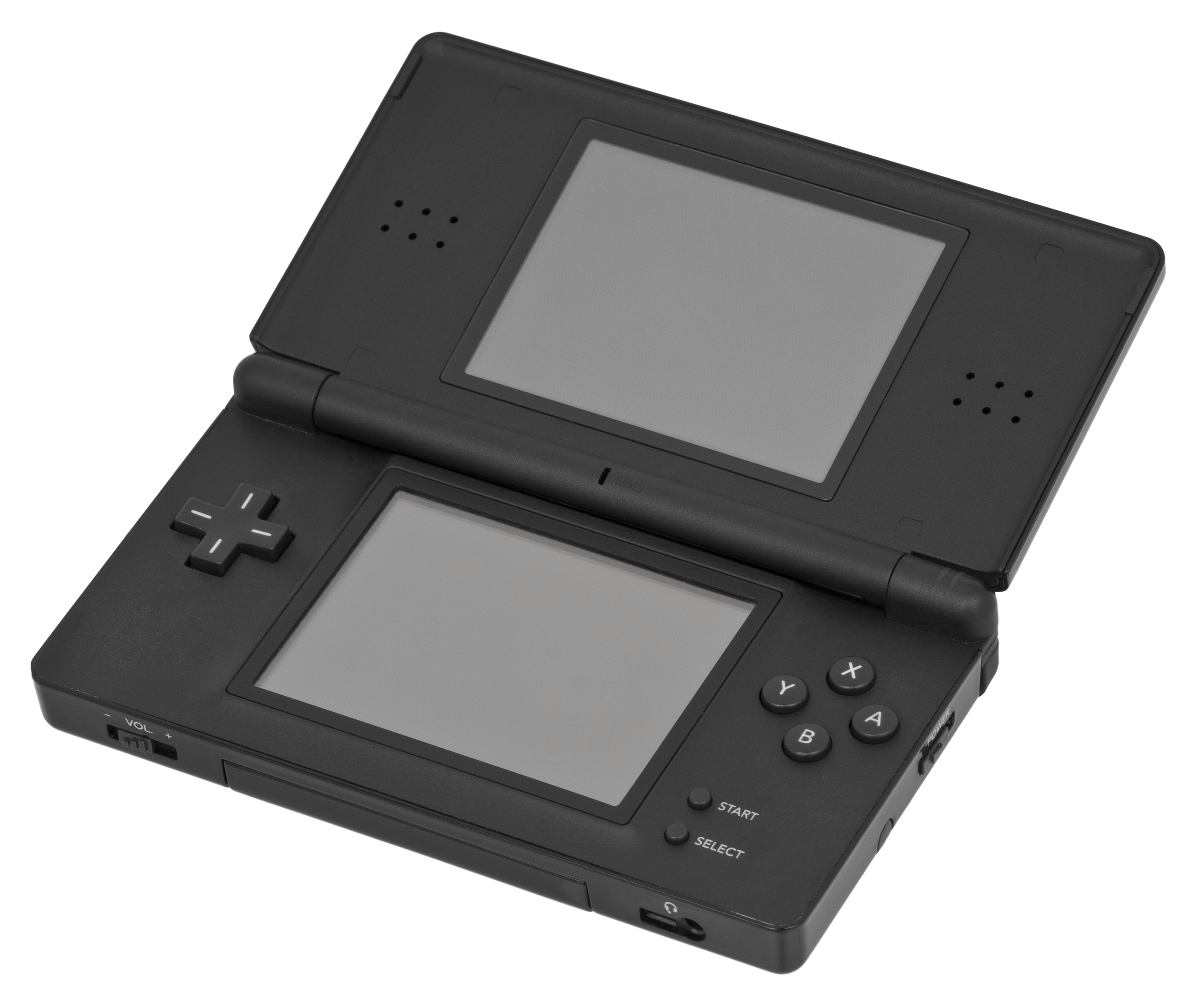
A Black Nintendo DS Lite.
By Evan-Amos - Own work, Public Domain, https://commons.wikimedia.org/w/index.php?curid=15734749
Links and prices were added and accurate in Fall 2026.
The Nintendo DS is an old, no longer sold handheld system. However, as of writing, they can still be found refurbished for around $120 from retailers like Walmart and Amazon. Add an R4 card for $15, $30 if you need a microSD card, and you have a capable handheld console you can give your child with a large library of games for about $150.
Why would you want to get your child a console that’s 20 years old? Well, since it’s about as old as Facebook, it has some properties that I think today count as features.
-
The Nintendo DS had a separate charging cable and brick that could only be used for the DS. In turn, no other cables could - or can - be used to charge it. This means you can limit playtime by limiting access to the charging cable, as getting one requires access to either a local retro game store or some online retailer like Amazon. A child can’t just grab any random USB-C cable. They can only use the one cable you can keep track of.
The parental control here isn’t some complex new system of accounts and permissions you need to learn and manage. It’s just a cable you can confiscate as necessary or provide as a reward. -
The original DS had a battery life of around 10 hours. The later DS Lite has a battery life of 15-19 hours depending on the game and display brightness. While this does theoretically allow for gaming all day on a single charge, it also means your child doesn’t need the cable as often, and you can manage playtime with the cable. 15-19 hours of play in one day is a lot, but it’s also a lot over the course of a week.
What this enables is, as your child gets older, you can teach them to manage their playtime. They can get one charge on Saturday to use as they like until the following Saturday (~2h/day). Or maybe only provide a charge every other week (~1h/day). Of course, if you need greater restriction, you can always restrict access to the device itself. Which ties into the next point. -
While any smartphone, laptop, or tablet you provide can double-up as a content device, it’s much easier to set blanket restrictions than to have a complex system of permissions that still leave games installed, visible, and tempting on the device. Having your child’s recreational/gaming device be bespoke means you can provide a device only for communication and not have to worry about them draining the battery by gaming or bypassing your restrictions because you forgot some setting or toggle.
This also applies to laptops and tablets, of course. You don’t need to worry about your child swiping away to play a game that isn’t even installed because they aren’t gaming on their school computer. -
While the DS and some games support wireless communication, they only support local wireless. Two people need to be in the same room to play together. This means no internet access, and no games built around gambling, FOMO, or dark patterns to entice consistent, recurring purchases.
Technically, some methods to connect to the internet were created later, especially with the DSi, but for all practical purposes today, the DS is an offline device. If your child figures out a way to connect to the internet on it, they deserve a high five and you should be happy to have such a techie kid. -
With a screwdriver, a spudger, and some patience, nearly every component is replaceable. The battery is the easiest to remove and replace, requiring only a basic Phillips head screwdriver to loosen the captive screw on the back.
-
If you don’t know anything about games, this section is going to feel a bit overwhelming. If you know anything about games, I hope to surprise you with the gaming culture that is available on the DS. Warning: Many links ahead. Check their ESRB rating (or whatever you prefer) for information about their content and whether they’re appropriate for your child. I’ll be running the gamut here.
If you take a look at the top selling DS games and know anything about games, you’ll immediately notice some classics. On the Nintendo side, you have Mario (2D, 3D, and Kart), Pokemon (main series, Rangers, and Explorers), Animal Crossing, Zelda, Kirby, Metroid, Donkey Kong, and Rhythm Heaven represented.
With third party franchises, you have Final Fantasy (classic and Tactics), Lego, Sonic, Kingdom Hearts, Castlevania, Dragon Quest, Cooking Mama, Plants vs Zombies, Phoenix Wright, Mega Man, and Shin Megami Tensei. And as a quick wrap up, there’s also Nintendogs, Chrono Trigger, The World Ends With You, Golden Sun, and Radiant Historia.
And I’ve not even touched the surface of the many weird, niche titles and movie or TV tie-ins for everything from Garfield to Victorious. And while many of these are quite bad, there is a lot of fun to be had in exploring them today without having to pay $30 or more for each. Remember, these games had to come out physically on expensive cartridges. Even the worst ones often had a surprising amount of (albeit misplaced) effort.
Hopefully this has piqued your interest. I’ll be publishing an article soon to guide you step by step through the process of ordering and setting up a DS for gaming.